When selecting a vitamin D supplement, choose vitamin D3 over D2, as D3 is more effectively absorbed and maintains blood levels longer. Look for high-quality brands that conduct third-party testing to confirm purity and potency. Verify the label for appropriate dosage, clear ingredient lists, and avoid unnecessary additives. Consider delivery formats like softgels or liquids with healthy fats for better absorption. Ensuring proper storage and consulting healthcare providers can support safe, effective supplementation. Continuing here provides further understanding for your choice.
Takeaways
- Choose vitamin D3 over D2 for better absorption, longer-lasting blood levels, and overall health benefits.
- Verify third-party testing and GMP certification to ensure supplement purity, potency, and label accuracy.
- Opt for oil-based formats like softgels or liquids, which enhance bioavailability through healthy fats.
- Check dosage guidelines to stay within safe limits; avoid excess to prevent toxicity.
- Select products with transparent ingredients, clear labeling, and preferably derived from natural sources like lichen for vegans.
What Is Vitamin D and Why It’s Important

Vitamin D is a fat-soluble nutrient that functions similarly to a hormone, and your body can produce it when your skin is exposed to sunlight. Sun exposure, along with food sources like fatty fish, egg yolks, cheese, and fortified foods, provides vitamin D. These sources help maintain adequate levels, supporting bone health, immune function, and muscle movement, especially when sun exposure is limited. Serum 25(OH)D levels are the primary indicator of vitamin D status and overall adequacy.
A robust body of evidence also shows that vitamin D status can be influenced by the form you take and how your body processes it, which underscores the importance of choosing a reliable supplement when sunlight or dietary intake is insufficient. Absorption efficiency varies between vitamin D2 and D3, and choosing a high-quality product can help ensure you attain and maintain optimal levels.
Why Vitamin D3 Is the Best Choice Over D2
Vitamin D3 is more effectively absorbed by the body, leading to higher and more consistent vitamin D levels. It also lasts longer in the bloodstream, maintaining these levels over time and reducing the need for frequent doses. Because D3 is naturally compatible with the body’s processes, it’s generally the preferred choice for correcting deficiencies. Studies have shown that D3 increases serum vitamin D levels more effectively than D2, supporting its use as the superior supplement. Additionally, there is evidence that vitamin D3 supports immune function and overall wellbeing beyond bone health, which may contribute to a more comprehensive approach to maintaining health. Absorption efficiency can vary based on formulation and dosing, so choosing a high-quality product matters.
Superior Absorption Benefits
Research shows that D3 is more effective than D2 at raising blood levels of 25(OH)D, the marker used to measure vitamin D status.
Its superior absorption efficiency results from better supplement formulation, leading to higher serum responses.
This enhanced absorption allows D3 to deliver more biologically active vitamin D, making it the preferred choice for improving vitamin D levels effectively.
Longer-Lasting Effects
D3 produces a longer-lasting increase in blood vitamin D levels compared to D2, making it more effective for maintaining consistent vitamin D status over time.
Its longer persistence supports better Sunlight harmony and is less dependent on supplement timing. This stability benefits individuals during seasons with limited sunlight, ensuring ongoing vitamin D levels without frequent dosing adjustments.
Natural Body Compatibility
Because vitamin D3 closely resembles the form produced naturally in your skin after sunlight exposure, it’s considered more compatible with your body’s biological processes.
Genetic factors influence how well your body absorbs vitamin D, leading to absorption variability.
D3’s natural similarity allows for better utilization, making it more effective for supporting overall health and maintaining consistent vitamin D levels.
How Much Vitamin D Do You Need Daily? Safe Dosage Tips
Understanding how much vitamin D you need daily is vital for maintaining health and preventing deficiency.
Dosage guidelines vary by age, with adults typically requiring 600 to 800 IU daily, and safe upper limits set at 4,000 IU.
To guarantee supplement safety, avoid exceeding these limits unless directed by a healthcare professional, especially for children and older adults.
Which Delivery Format Enhances Absorption and Effectiveness?
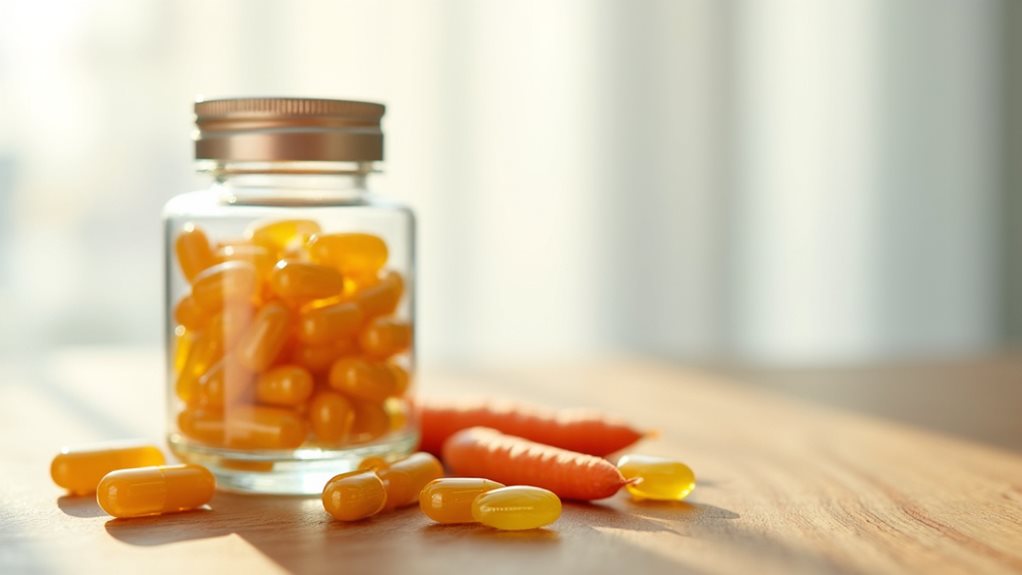
Since vitamin D is fat-soluble, using oil-based formats like softgels or liquids enhances absorption compared to powder-based forms.
These formats support dispersion in the gut, increasing the effectiveness of the supplement.
Taking vitamin D with fatty foods or in oil vehicles generally results in better blood levels and more consistent results.
In addition, ensuring adequate sun exposure and maintaining steady intake can help sustain immune-supporting levels over time. fat-soluble vitamin
Fat Soluble Nature
Vitamin D’s fat-soluble nature means that its absorption largely depends on its dissolution in lipids, rather than water.
The supplement formulation influences lipid absorption, with oil-based formats enhancing bioavailability over powders or ethanol vehicles.
Lipid carriers support absorption, especially when combined with healthy fats in meals, improving serum vitamin D levels and overall supplement effectiveness.
Optimal Delivery Formats
Different delivery formats for vitamin D supplements can substantially influence how well the body absorbs and employs the nutrient. Oil-based carriers, such as softgels, improve absorption efficiency due to their lipid medium.
Microencapsulation offers even higher bioavailability and longer effects, while liposomal and nanoemulsion systems further enhance absorption by creating stable, efficient delivery mechanisms that maximize nutrient uptake and effectiveness.
Are Vegan and Vegetarian Vitamin D3 Supplements Available?

Are vegan and vegetarian vitamin D3 supplements readily available to consumers? Yes, vegan sources like lichen-derived D3 are accessible in various forms, including tablets, capsules, liquids, and sprays. Label verification is essential, as products must specify vegan, plant-based, or lichen-derived D3 to confirm suitability. Availability includes mainstream and vegan-focused brands. In addition, sleep disruption and shift work do not change the basic fact that choosing vegan D3 requires checking for label verification to ensure plant-based sourcing.
How to Read Labels and Choose a High-Quality Vitamin D Supplement
Reading the labels on vitamin D supplements helps you determine their quality and suitability for your needs. Check dosage guidelines to guarantee the amount per serving matches your requirements. Ingredient transparency reveals fillers, preservatives, and additives, allowing you to assess formulation quality. Accurate label reading guarantees proper dosing, ingredient clarity, and helps you select high-quality supplements aligned with health standards. Vitamin D relies on proper calcium balance for bone health, so consider how supplements support this relationship as you evaluate products. calcium–vitamin D balance
Why Third-Party Testing Ensures Purity and Potency
Third-party testing provides an objective benchmark for quality and consistency, reinforcing consumer trust in verified brand claims. Label transparency remains a core goal of certification, ensuring that the stated vitamin D content matches what’s in the bottle.
What Ingredients Should You Look for and Avoid?

When selecting a vitamin D supplement, it’s essential to take into account its ingredients carefully, as they influence effectiveness and safety.
Look for clear dosage instructions, ingredient sources like D3 from animal or plant sources, and formulations with good absorption.
Avoid unnecessary additives, excess vitamin D, and products with unclear labels, ensuring ingredient transparency and dosage clarity.
Be mindful of potential allergens or fillers that could affect tolerance, especially if you have sensitivities or take multiple supplements. vitamin D measurement
Questions to Ask Before Buying Your Vitamin D Supplement
Before purchasing a vitamin D supplement, it’s essential to ask key questions that verify the product meets your needs and guarantees safety.
Inquire about storage conditions to guarantee stability and potency, as improper storage can degrade effectiveness.
Confirm manufacturing standards, such as GMP certification and independent testing, to guarantee quality, safety, and accurate labeling of dosage, form, and expiration date.
Be aware of signs of vitamin D toxicity, including symptoms like nausea, vomiting, weakness, and confusion, which can occur with very high intakes over time. Vitamin D toxicity
Frequently Asked Questions
Can I Take Vitamin D Supplements if I Have Existing Health Conditions?
Yes, you can take vitamin D supplements if you have existing health conditions, but medical considerations are essential. Consult your healthcare provider to determine appropriate dosage guidelines based on your health status.
Conditions like kidney disease or prediabetes may require adjusted doses. Monitoring blood levels of 25-hydroxyvitamin D helps avoid overdose, especially since excess intake can be harmful.
Follow professional advice to guarantee safe and effective supplementation.
How Do I Know if a Vitamin D Supplement Is Vegan-Friendly?
You can determine if a vitamin D supplement is vegan-friendly by checking for vegan sources and plant-based ingredients. Look for labels that specify “vegan” or “vegan-certified,” or identify vitamin D as “D2” or “lichen-derived D3,” which come from plant sources.
Examine the ingredient list for capsule materials like HPMC or pullulan, and verify that inactive ingredients are plant-based. Contact the manufacturer if the source of vitamin D is unclear.
Are Liquid Vitamin D Options More Effective Than Capsules?
Liquid form and capsule form of vitamin D are generally equally effective at raising serum (25(mathrm{OH})mathrm{D}) levels in most people.
The choice depends on individual preferences and needs, as liquids offer dose flexibility and easier swallowing, especially for those with difficulty swallowing capsules.
Capsules provide pre-measured doses and longer shelf life, but both formats deliver similar biological effects when taken correctly with dietary fat.
What Is the Difference Between USP and NSF Certification?
USP and NSF certifications differ mainly in their certification standards and focus on quality assurance. USP verifies identity, purity, strength, and manufacturing quality, ensuring label accuracy and contamination control.
NSF also verifies these aspects but adds screening for banned substances, which is essential for athletes.
Both certifications confirm product quality, but NSF’s scope includes broader safety measures for specific populations, while USP emphasizes general supplement quality.
How Should I Store Vitamin D Supplements for Maximum Potency?
Store vitamin D supplements in a cool, dry place between 59–77°F to preserve potency. Keep bottles away from heat sources and direct sunlight, as heat and light degrade nutrients.
Make certain containers are tightly closed after each use to prevent moisture entry, which can reduce effectiveness. Use the original packaging or opaque containers, and avoid temperature fluctuations.
Regularly check expiration dates to guarantee supplement strength remains intact.
And Finally
Choosing a high-quality vitamin D supplement involves checking for appropriate dosage, reliable delivery formats, and third-party testing. Guarantee the product contains pure ingredients and meets your dietary preferences, such as vegan options. Reading labels carefully helps avoid unnecessary additives. By selecting a supplement that aligns with safety standards and your individual needs, you optimize absorption and effectiveness, supporting overall health and bone strength. Proper selection is vital for achieving desired health benefits reliably.
References
- https://www.vogue.com/article/best-vitamin-d-supplement
- https://www.kelley-ross.com/a-helpful-guide-to-vitamin-d-supplements-how-to-choose-the-best-option-for-you/
- https://fortune.com/article/best-vitamin-d-supplements/
- https://news.yahoo.com/looking-vitamin-d-supp-choose-120000622.html
- https://www.which.co.uk/reviews/nutrition-and-supplements/article/best-vitamin-d-supplements-afvPf0y5YfU9
- https://www.medicalnewstoday.com/articles/best-vitamin-d-supplement
- https://www.garagegymreviews.com/best-vitamin-d-supplement
- https://www.prevention.com/food-nutrition/g35686472/best-vitamin-d-supplements/
- https://ods.od.nih.gov/factsheets/VitaminD-HealthProfessional/
- https://www.mayoclinic.org/drugs-supplements-vitamin-d/art-20363792